Thursday, October 21, 2021

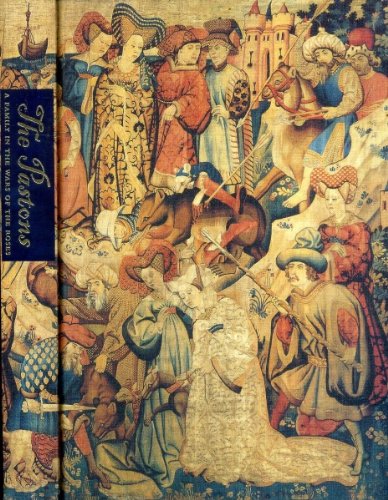
“The Pastons: A Family in the Wars of the Roses”, by Richard Barber


208 pages, The Folio Society 

So, it turns out that The Pastons: A Family in the Wars of the Roses by Richard Barber is in fact the second book I’ve read on this interesting family, the first being Blood and Roses: One Family’s Struggle and Triumph During the Tumultuous Wars of the Roses by Helen Castor (reviewed on October 5th, 2013). This, of course, is an edition from the Folio Society, so it’s bound beautifully and is printed on extra-special paper. So it’s a better read. Obviously. That, and the fact that its written by Richard Barber, who happens to be one of Britain’s leading authorities on medieval history. But just who were the Pastons, anyway? Well, as the subtitle states, they were an English family who, between 1426 and 1485 (that would be the Wars of the Roses), established themselves as a family of consequence, both in their native Norfolk and within court circles. Because so many of their letters have survived, they have come down to us as a unique repository of information about these wars that did so much to rip apart and destroy England over the course of the 15th Century.

Just like Castor in Blood and Roses, Barber in The Pastons relies on “The Paston Letters” for his primary source; these Letters refer to the correspondence, state papers and other important documents that were shared between members of this family of Norfolk gentry and their large circle of allies and acquaintances between 1422 and 1509. These papers were acquired from the estate of William Paston, 2nd Earl of Yarmouth (and the last of the Pastons) by the antiquary Francis Blomefield in 1735. From there, they were obtained by Thomas Martin, an antiquarian and lawyer, in 1752. On Martin’s death in 1771 some of the papers passed into the hands of John Ives, while many others were purchased by John Worth, a chemist, whose executors sold them in 1774 to Sir John Fenn, yet another antiquarian, who was the first to publish them after this convoluted trail of ownership. Without question, all of these men did future historians a great service by preserving these papers, as they offer a brilliant insight into the blood feud known as the Wars of the Roses from a family that lived a fought through it.

For the Pastons were in the thick of it, make no mistake, and Barber uses his expertise in this area to set their correspondence in their proper context as we follow this family through their triumphs and tragedies. The urgency – and, often, the violence – of their preoccupations come to us across the centuries as if they happened yesterday: their courtships, their estates, their cupboards; their properties, their cases, their alliances. This is more than just a collection of the Pastons correspondence, for Barber weaves their story together using their own words as bridges from their time to ours. A wonderful addition to anyone’s library of Medieval England in general and the Wars of the Roses specifically.

Monday, October 18, 2021

“Hunger’s Brides: A Novel of the Baroque”, by Paul Anderson


1376 pages, Da Capo Press, ISBN-13: 978-0786715411

Paul Anderson’s Hunger’s Brides: A Novel of the Baroque is as baroque as its subject matter. Donald Gregory was once a respected college professor who had a penchant for seducing students; one winter’s evening he visits the apartment of one Beulah Limosneros, a student and former lover, only to find her there, dying. This in itself is a shock, as she had disappeared two years prior when, chasing her obsession for Sor Juana Inés de la Cruz (Sister Joan Agnes of the Cross), she had traveled to Mexico on her quest. In a panic, he seizes the box he finds and flees into the cold night. With the police closing in around him, Gregory examines the contents of this box and finds a wealth of treasures connected with the sainted Juana: Beulah’s travel journal, her research notes on the Spanish conquest of the Americas and the Inquisition, private diary entries (concerning him) and a strange manuscript about Sor Juana. But who was Sor Juana? Why was Beulah obsessed with her? And where does Gregory fit in to all this?

As one can tell by this thumbnail sketch, Hunger’s Brides is not easy to quantify: part mystery, part history, part poetic, part novelistic – there's a lot going on here, for Paul Anderson has written an encyclopedic epic about this little-known (outside of Mexico) nun/poetess of the late 17th Century and her obsessive 20th Century researcher. At almost 1400 pages and weighing almost 5 pounds, Hunger’s Brides is reminiscent of the old social conscience potboilers of the 19th Century: think Les Misérables by Victor Hugo, or War and Peace by Leo Tolstoy, or even In Search of Lost Time by Marcel Proust, each of whom not only created memorable characters and complex plots, but also lengthy social observations on topics which did not necessarily advance the plot, but which got the author’s viewpoints across, often at their own expanse (perhaps Anderson should have followed Proust’s example and published this many-layered novel filled with history and poetry in several volumes?).

But I suspect that both Anderson and the editor fell under Sor Juana’s spell and could not bear to pare much from her extraordinary life. This illegitimate daughter of a 17th Century Mexican rancher was a genius with a mind that today still defies explanation (hence her enduring fascination). Her wit, her intelligence, her writings and, not least, her spirituality lead the Viceroy of New Spain to demand the teenage Juana’s presence in Mexico City, but she left after only a few years to enter one of the most restrictive convents in the city, where she felt she would not be distracted from her writing. Her beauty and brilliance made her convent cell a popular meeting place for the intelligentsia of New Spain, but between visits she wrote quite unchaste poetry that took the world by storm. Then, suddenly, she stopped, never to write again. This mystery has entranced scholars form her day to ours, it entranced Anderson enough to write this brick of a book and, by the time you (eventually) finish, it will entrance you, too.

Friday, October 15, 2021

“Kingdoms of Europe: An Illustrated Encyclopedia of Ruling Monarchs from Ancient Times to the Present”, by Gene Gurney


627 pages, Crown Publishers, ISBN-13: 978-0517543955

Man, did I hate high school, and I couldn’t wait to get paroled – er, graduate. In my junior year (that would be 1989) I went on a school band trip to Arizona and San Francisco, and it tells you something that the highlight for me was in buying Kingdoms of Europe: An Illustrated Encyclopedia of Ruling Monarchs from Ancient Times to the Present by Gene Gurney. This book was already seven years old when I bought it but still current, which one can no longer say; however, keeping in mind that everything up until the 80s is still accurate, there’s no reason to pick one up for yourself. I look back at that time and still marvel at my relative ignorance, for when I cracked open this book and began reading, I still recall the rush I still felt at discovering new facts and discovering interesting people from the far and near past. Every nation in Europe is given a brief once-over – even nations that no longer exist, like the Roman and Ottoman Empires – with the smaller, easily forgotten countries given their due – like Andorra, for instance.

Seeing as the title of the book is Kingdoms of Europe, the focus is rather old-school, on the monarchs that reigned and ruled over these countries from the mists of myth to the klieg-lights of modern-day celebrity culture; thus, the lives of these monarchs serves as the driving force for the narrative, with their words and deeds serving to propel their kingdoms forwards or, just as likely, drive them back. Anyone looking for insights into the everyday lives of the peasants who toiled in the fields or a social history of the differing classes in these kingdoms will be sorely disappointed. Besides that, there are thousands of pictures and photographs spread throughout the book, illustrating, literally, just what it is the author is talking about (several of these are hand-drawings that I have never seen anywhere else; looking at them again in preparing for this review was like seeing long-lost friends).

Kingdoms of Europe is a great introductory work on European history, constrained as it is by focusing on royalty and by its own datedness. No matter: pick one up, crack it open and get straightened out as to just who ruled what and when.